Will AI Ever Replace Human Touch?
Why Sensual Massage May Matter More Than Ever
Artificial intelligence is transforming relationships, communication and even the way we think about sex and intimacy. But as technology becomes more sophisticated, could learning the very human skill of sensual massage become more important rather than less?
Artificial intelligence is rapidly changing how we work, communicate, learn, date and form relationships. Over the coming decades, AI companions and increasingly sophisticated robotics may become part of everyday life.
But could AI ever replace something as fundamentally human as sensual massage and intimate touch?
At Intimacy Matters, after more than 20 years working with human touch, intimacy and sexual wellbeing, I believe there is an important distinction between reproducing the mechanics of touch and reproducing the human experience of being touched.
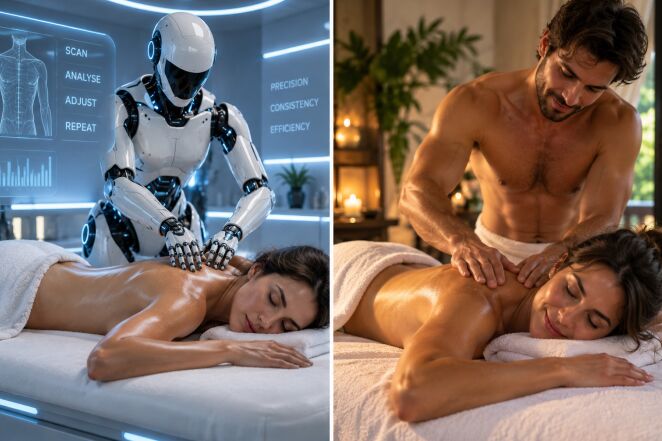
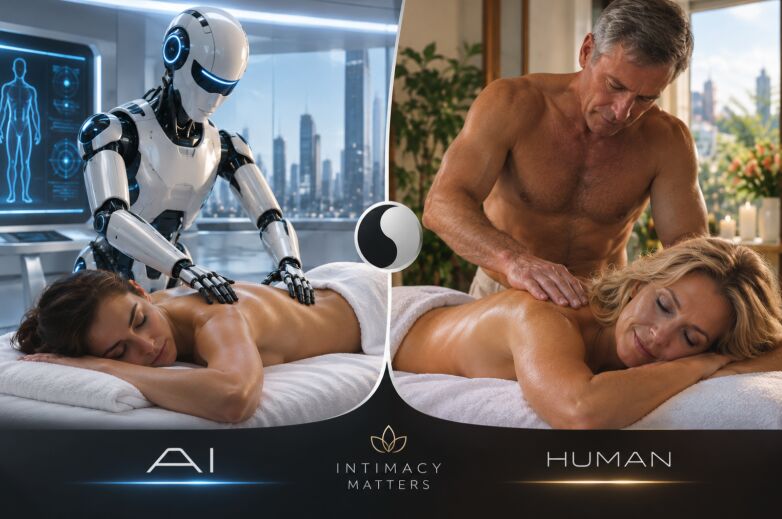
A machine may eventually become extraordinarily good at massage. Equipped with AI, sensors and robotics, it could potentially reproduce pressure, warmth, rhythm and thousands of movements. It might recognise changes in breathing, heart rate or muscle tension and respond accordingly.
But sensual massage is about considerably more than performing the correct movements.
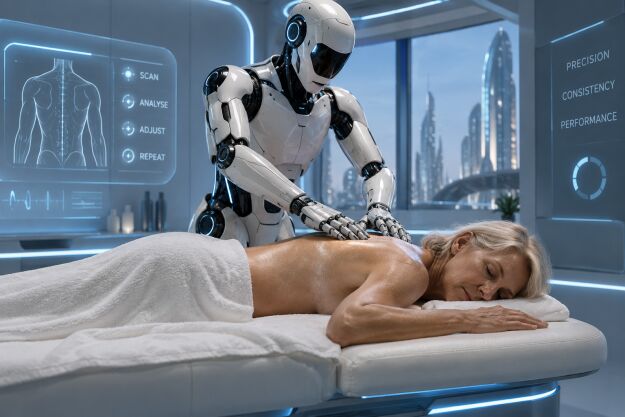
Human touch is communication
When one person touches another, two human beings are communicating without necessarily saying anything.
An experienced sensual masseur notices subtle changes: breathing becoming deeper, muscles relaxing, a small movement towards or away from touch, tension disappearing, confidence growing or somebody simply becoming more comfortable in their body.
Experience and intuition influence what happens next.
Sometimes the appropriate response is slowing down. Sometimes it is changing the quality of touch. Sometimes it is simply allowing a moment to develop without rushing towards the next technique.
Importantly, the person receiving knows that another human being is choosing to give them attention, presence and touch.
That psychological dimension of intimacy is difficult to separate from the physical sensation itself.

Touch, arousal and sexual performance
This becomes particularly important when we consider sexual confidence and performance.
Modern sex can easily become goal-orientated. People may worry about becoming sufficiently aroused, maintaining an erection, reaching orgasm, helping their partner reach orgasm or simply whether they are “doing it properly”.
Those thoughts can themselves interfere with enjoyment.
Sensual massage provides another approach. It can slow the experience down and move attention away from performance and towards sensation, anticipation, communication and pleasure.
For couples, learning sensual touch can expand what they regard as sex. Intimacy no longer has to revolve around intercourse or orgasm. Instead, arousal can develop gradually through the whole body.
Learning to recognise a partner’s responses can also make someone a more attentive lover. Breathing, movement, muscular tension, sounds and other subtle responses provide information that cannot always be captured by following instructions or repeating a predetermined technique.
The objective isn’t simply to learn where to touch, but to develop sensitivity to how, when and why touch feels right for this particular person at this particular moment.

Where experience and intuition matter
This is where an experienced human practitioner can offer something fundamentally different from technology.
Over thousands of hours of working with people, practitioners develop pattern recognition. Yet every person arriving at Intimacy Matters brings a different body, personality, relationship history, confidence level and experience of intimacy.
There is therefore no single perfect sensual massage.
Humanistic sensual massage is responsive. Technique provides the foundation, but empathy, communication, consent, experience and intuition determine how those techniques are applied.
This can be particularly valuable for people who have become disconnected from their sensuality, whose sex lives have become repetitive, or who simply want to discover different ways of experiencing pleasure and intimacy.
Technology can provide information. Human experience helps us understand another human being.
Could AI actually make human touch more valuable?
There is an interesting paradox.
The more sophisticated technology becomes, the more valuable genuinely human experiences may become.
We already see couples sitting beside each other while looking at separate screens. AI could make digital life even more personalised, compelling and absorbing.
One way of counterbalancing that development is remarkably simple:
Learn how to touch another human being well.
Learning sensual massage requires us to put the phone down, stop looking at a screen and devote our attention to another person.
For couples, it can create a new language of intimacy and help prevent sex becoming predictable or purely goal-orientated.
For individuals, learning sophisticated touch, communication and boundaries can become a relationship skill they carry throughout their lives.
Learning sensual massage for the AI age
At Intimacy Matters and the School of Sensual Massage, we have spent more than 20 years exploring the relationship between touch, arousal, intimacy and sexual fulfilment.
Perhaps the next 20 years will make those skills even more relevant.
We should embrace AI where it genuinely helps. Technology can teach anatomy, explain aspects of arousal and sexual psychology, provide educational resources and help students revise what they have learned.
But ultimately, those resources should help people become better at connecting with other people, not provide a substitute for connection.
Sexual fulfilment is not simply an engineering problem for technology to solve. It grows from communication, attraction, trust, vulnerability, confidence, curiosity and the extraordinary complexity of two human beings responding to each other.
That is why learning sensual massage could become an increasingly valuable antidote to an AI-dominated world.
The future may contain extraordinary technology, but perhaps one of the most valuable skills we can take into that future isn’t technological at all.
It is learning to put technology aside, give another person our complete attention and rediscover the extraordinary power of human touch.
AI may eventually master the choreography of touch. But the deeply human experience of touching—and being touched by—another person belongs to us.