The Complexities of the Female Orgasm
Why Some Women Struggle to Reach Orgasm — and How Sensual Massage Can Help Them Rediscover Their Sexuality
By Colin Richards – Sex & Intimacy Engineer, Intimacy Matters

For some women, reaching orgasm is a natural and relatively effortless experience. For others, it can be unpredictable, frustrating or seemingly impossible. Some women can orgasm easily through masturbation but struggle when making love with a partner. Others have enjoyed sexual relationships for decades without ever experiencing what they recognise as an orgasm.
And then there are women who can orgasm but remain curious about the different sensations, intensities and varieties of sexual pleasure their bodies might be capable of experiencing.
Over more than twenty years working with women of different ages, backgrounds and sexual experiences, I have come to appreciate just how individual and complex female sexual arousal can be.
One of the most important things I explain to women who come to see me is that orgasm is not simply a physical response to stimulation. It is an interaction between the body, brain, emotions, sensations and the ability to feel comfortable enough to become fully absorbed in pleasure.
Understanding this relationship is often the first step towards a more fulfilling sexual life.
What Does the Female Orgasm Survey Tell Us?
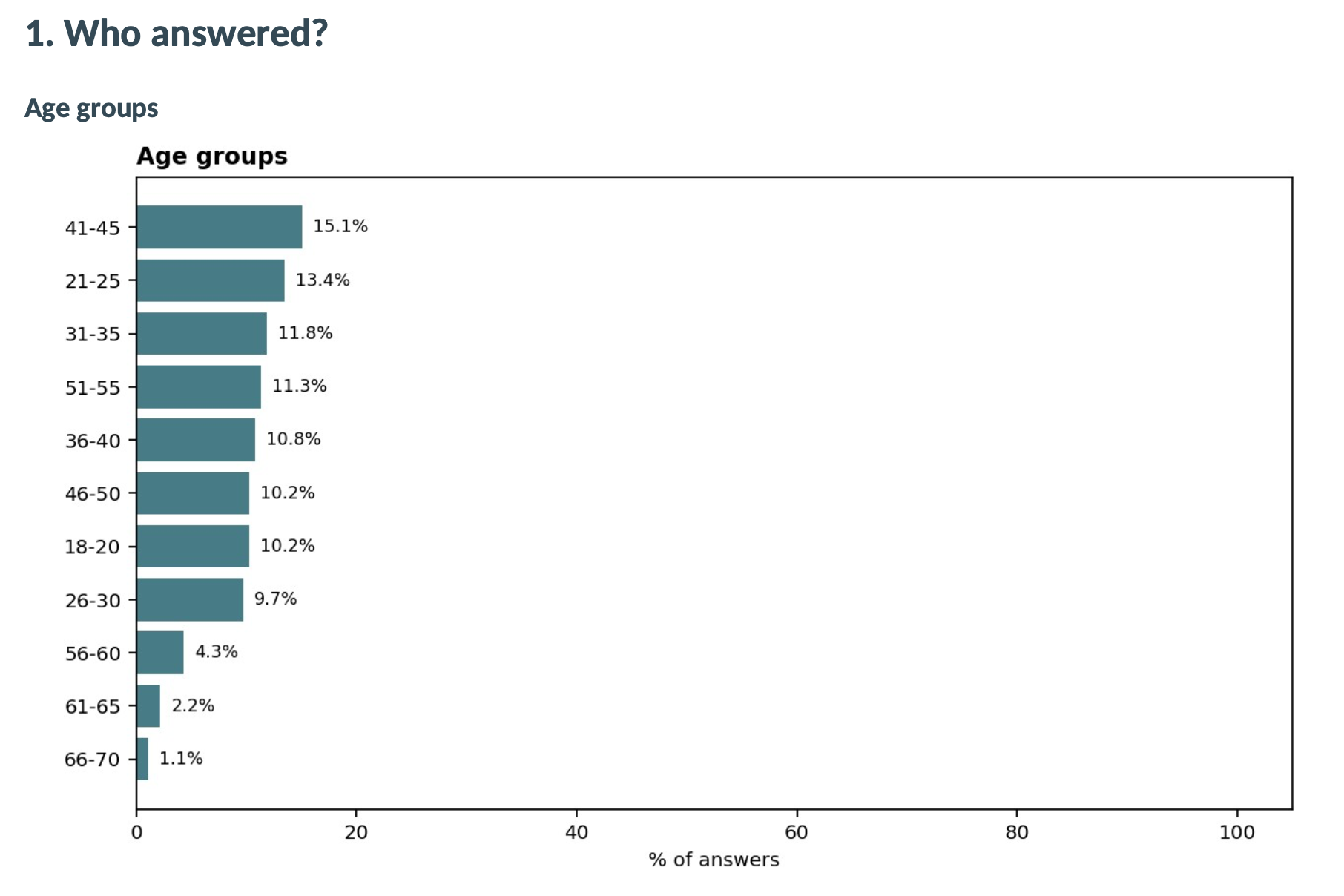
My recent Intimacy Matters Female Sexuality and Orgasm Survey, involving 187 respondents, illustrates just how varied women’s experiences can be.
For example:
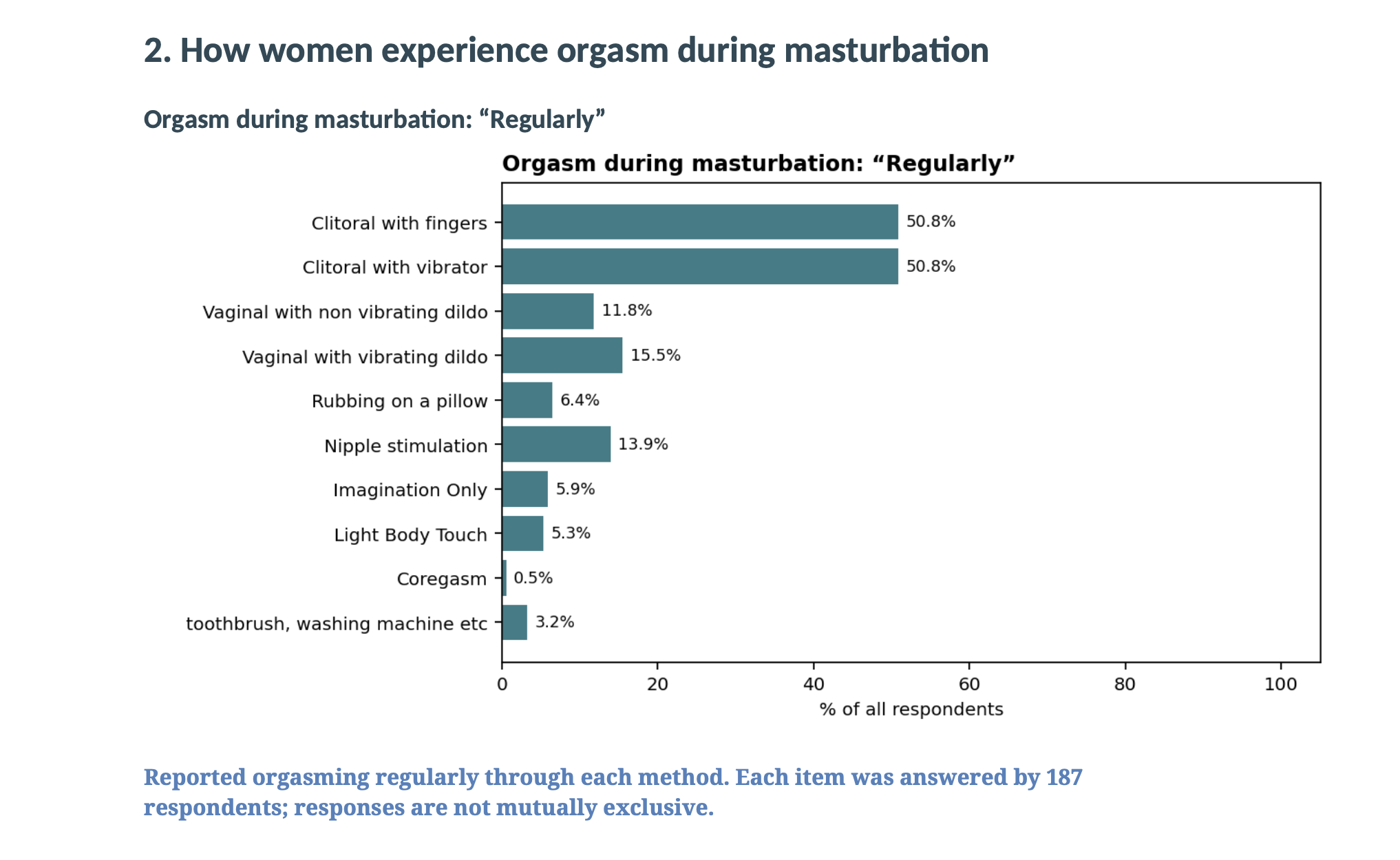
- 50.8% reported regularly reaching orgasm through clitoral stimulation with their fingers during masturbation.
- 50.8% also reported regularly orgasming using a vibrator.
- 36.4% regularly reached orgasm through clitoral stimulation by a partner’s fingers.
- 36.4% regularly orgasmed through oral stimulation.
- Only 27.8% reported regularly reaching orgasm through vaginal penetration.
- 56.1% agreed or strongly agreed that they generally tend to be anxious.
These figures describe the women who responded to this survey, rather than women generally, and the percentages are not mutually exclusive.
Nevertheless, they highlight something important: being able to orgasm through masturbation does not necessarily mean a woman can achieve the same response with a partner.
They also challenge the common assumption that penetrative intercourse should be the principal route to female orgasm.
For many women, clitoral stimulation, the pace of arousal, emotional connection and the freedom to concentrate entirely on their own sensations are far more important.
The survey also raises questions about anxiety and its possible relationship with orgasm difficulties. However, it cannot establish that anxiety causes anorgasmia.

Understanding Anorgasmia
Anorgasmia is the medical term used to describe persistent difficulty or inability to reach orgasm despite adequate sexual stimulation and arousal.
There are several different experiences.
Lifelong or primary anorgasmia describes women who have never experienced an orgasm, whether alone or with another person.
Acquired or secondary anorgasmia describes women who previously experienced orgasm but subsequently developed difficulties.
Situational anorgasmia describes women who can orgasm in certain circumstances, perhaps through masturbation, but struggle during partnered sexual activity.
These distinctions matter because the reasons behind orgasm difficulties can be very different.
Medication, hormonal changes, neurological conditions, pain, insufficient stimulation and relationship difficulties can all contribute. Psychological influences, including anxiety, shame, past experiences and pressure to perform, may also play a role.
Not every woman who has difficulty orgasming has a disorder. Whether the difficulty causes personal distress is an important consideration.

When the Mind Interrupts the Body
One of the most common experiences women describe to me is feeling physically aroused but mentally unable to surrender to the experience.
They may enjoy being touched, experience lubrication and feel sexual excitement, yet the anticipated orgasm never arrives.
Sometimes the difficulty is simply that their partner does not understand the type, rhythm or duration of stimulation they need.
For others, the problem is more psychological.
A woman may be thinking:
Am I taking too long? Is my partner getting bored? Why isn’t it happening? What if I disappoint them?
The more she worries about reaching orgasm, the more elusive it may become.
I have also worked with women who describe themselves as naturally anxious, highly responsible or constantly busy. They are accustomed to organising, anticipating problems and looking after other people’s needs.
These characteristics may serve them extremely well in everyday life. But during sexual intimacy, that same constant mental activity can make it difficult to concentrate on their own pleasure.
Some women have also developed a strong need to remain in control, perhaps because of earlier experiences that made vulnerability feel uncomfortable or unsafe.
For them, learning to relax during intimacy may involve developing trust, emotional security and confidence in expressing their needs.

The Natural, Primal Process of Female Arousal
Human sexual arousal is an intricate interaction between our nervous system, emotions, imagination, hormones and physical sensations.
Long before modern relationships, language and social expectations, touch played an important role in human bonding and communication.
Being held, stroked, caressed and physically reassured can create feelings of closeness, comfort and security.
I believe this natural, primal language of touch remains an important part of our sexuality.
For many women, arousal develops most comfortably when they feel safe, desired, appreciated and free from expectations.
Sensual touch can encourage a gradual transition from everyday mental activity towards greater awareness of bodily sensations.
As a woman relaxes, she may become more receptive to pleasurable stimulation, allowing arousal to develop without the pressure of having to reach a particular outcome.
This does not mean relaxation alone will overcome every orgasm difficulty. But for women whose arousal is disrupted by anxiety, distraction or self-consciousness, it can be an important part of the process.
How Sensual Massage Can Help
At Intimacy Matters, I use sensual massage as an opportunity for women to explore their bodies, sexual responses and capacity for pleasure in a private, supportive and non-judgemental environment.
Unlike conventional partnered sex, there is no expectation to reciprocate, satisfy another person or progress towards intercourse.

The experience is entirely centred on the woman receiving the massage.
My approach begins with relaxation, using traditional full-body massage techniques to encourage physical comfort and ease.
As the session develops, and entirely according to her wishes and consent, the massage can become more sensual and intimate.
This gradual progression allows her to experience the natural development of arousal, paying attention to sensations rather than concentrating on achieving an orgasm.
For some women, this may help them discover that they respond to forms of touch they have rarely experienced before.
For others, the greatest benefit is learning that they can enjoy being physically intimate without feeling responsible for another person’s pleasure.
And for women who struggle with orgasm, the experience may help identify whether their difficulties relate to the type of stimulation, the pace of arousal, anxiety or other emotional factors.
Orgasm is never guaranteed, nor is it a requirement for a successful session.
The Absolute Sensual Massage Experience
My Absolute Sensual Massage is designed to provide women with a comprehensive experience of sensual and erotic touch, combining relaxation, bodily awareness and sexual exploration.
Depending on the chosen treatment and individual preferences, the massage can include full-body sensual touch, clitoral stimulation and optional internal vaginal stimulation, including exploration of sensations associated with the anterior vaginal wall, sometimes referred to as the G-spot.
The experience can be adapted to women who prefer gentle, gradual exploration or those who already enjoy orgasm but wish to discover different sensations.
Some women are curious about more intense orgasms, repeated orgasms, whole-body sensations or female ejaculation. These experiences vary considerably between individuals, and none should be regarded as a measure of sexual success.
The Absolute Massage offers an opportunity to explore these possibilities without the usual expectations of partnered sexual activity.
Before the session, each woman can discuss her interests, concerns and boundaries. Nothing is included without her agreement, and she can change her mind or stop at any point.

For Women Who Have Never Experienced Orgasm
For women with lifelong anorgasmia, I offer a more considered approach through my Psychosensual Treatment, combining confidential conversation with an individually tailored sensual massage experience.
We begin by exploring her sexual history, previous experiences, anxieties and what she hopes to achieve.
Where appropriate, I encourage medical assessment to identify possible physical or medication-related causes.
The massage element then provides an opportunity to experience pleasurable touch in a setting where there is no pressure to perform.
Some women may discover new sensations or achieve orgasm. Others may benefit from becoming more comfortable with their bodies, understanding their arousal patterns and developing confidence in expressing their sexual needs.
Progress is individual, and some women may benefit from further psychosexual therapy or medical support.
A Safe, Private and Confidential Place to Explore
I appreciate that arranging a sensual massage, particularly when discussing deeply personal orgasm difficulties, can feel like a significant step.
Some women have never spoken openly about their sexuality before. Others may feel embarrassed, uncertain or worried about being judged.
At Intimacy Matters, I provide a private and confidential environment where women can discuss these subjects openly and without embarrassment.
Whether you have never experienced an orgasm, struggle to reach one with a partner, or simply want to explore a broader range of sensual and sexual pleasure, your experience is approached individually and respectfully.
There is no expectation to achieve anything, no obligation to accept any particular form of touch and no judgement about your sexual history, relationships or desires.
The aim is not simply to achieve an orgasm. It is to help you better understand your body, feel more confident in your sexuality and discover what genuinely brings you pleasure.
Female sexual fulfilment should never be measured solely by whether an orgasm happens.
Sometimes the most meaningful discovery is simply learning how to relax, receive pleasure and enjoy being yourself.
Discover More at Intimacy Matters
If you experience difficulties reaching orgasm, or would like to explore your sensuality and sexual responses in a safe, confidential environment, I welcome you to contact me for a private discussion.
Female Orgasm & Masturbation Survey Results
187 submitted responses · Survey dates: 2017-11-02 to 2026-11-15
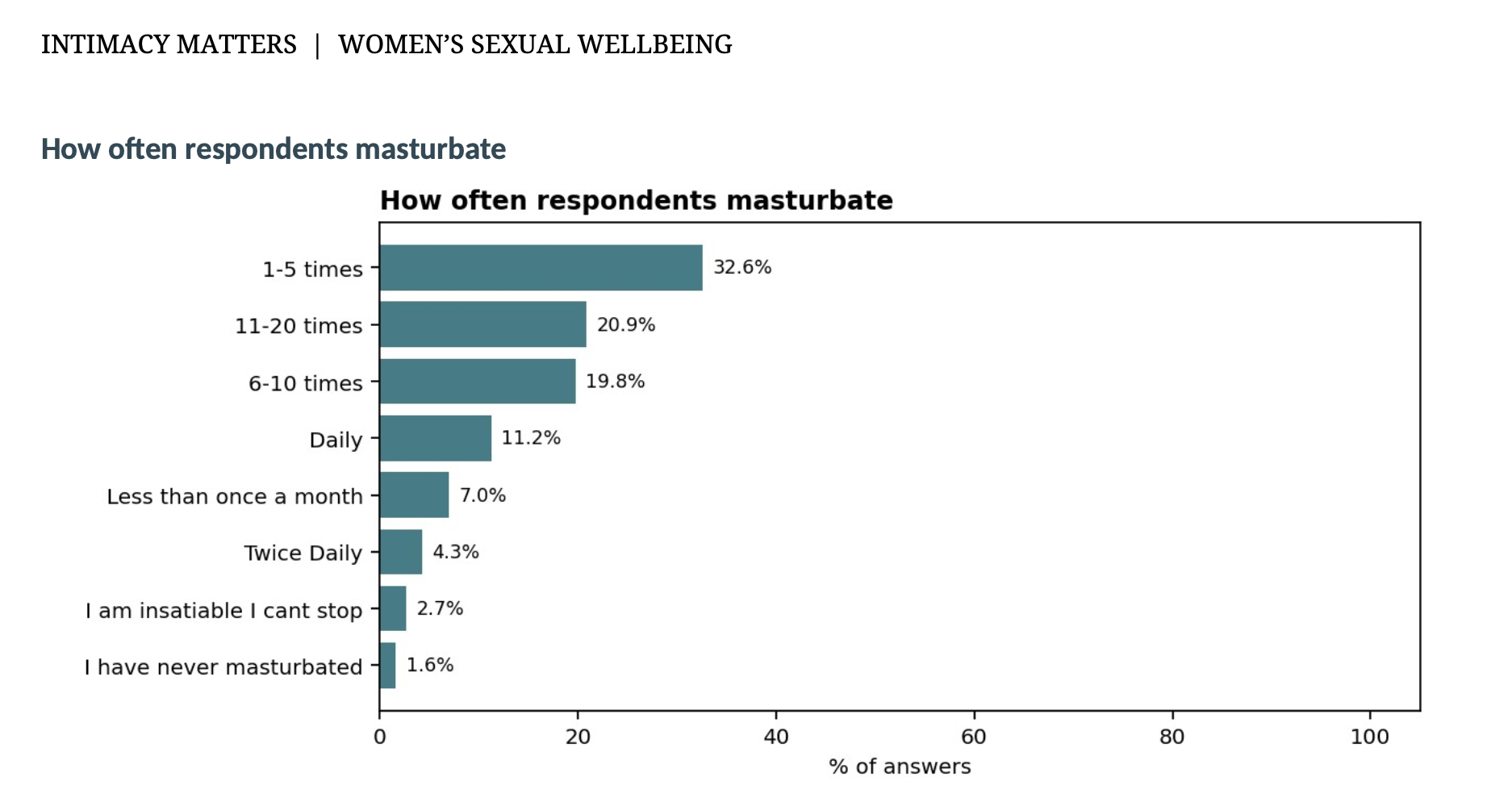
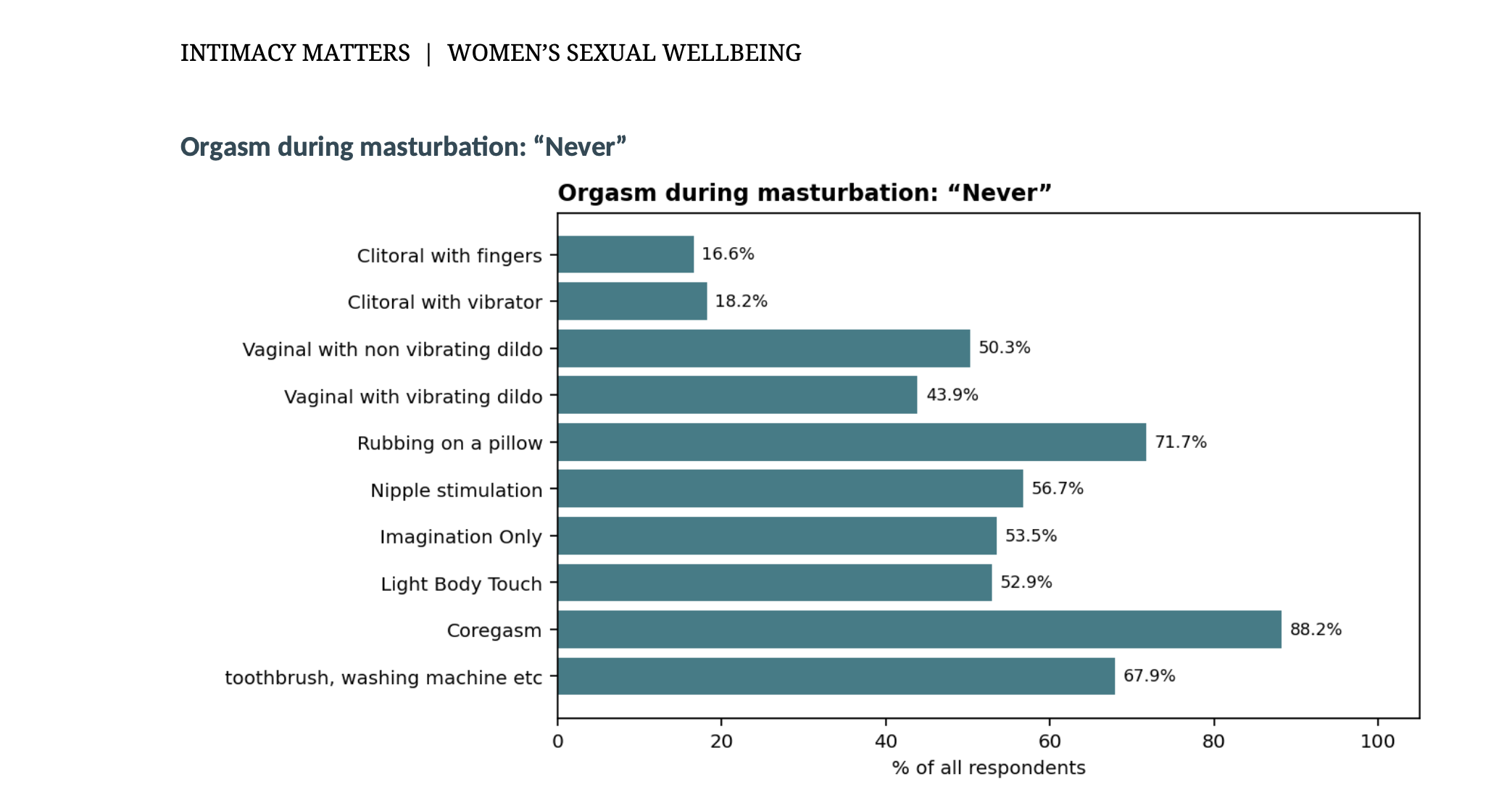
This report describes the experiences of women who chose to complete this survey. It is not a representative sample of all women, and percentages should not be treated as universal norms. There is no single correct frequency, method or type of orgasm. How to read the charts: bars show the percentage of respondents choosing each answer. For multi- item questions, each activity is rated separately, so percentages across activities do not add up to 100%. “Never” can mean an activity was not tried, did not cause orgasm, or was not applicable; the survey does not distinguish these possibilities.
Below are four examples of the questions answered in the survey. To read the full survey, click on the link below
https://www.intimacymatters.co.uk/images/Female_Orgasm_Survey_Illustrated_Guide.pdf