
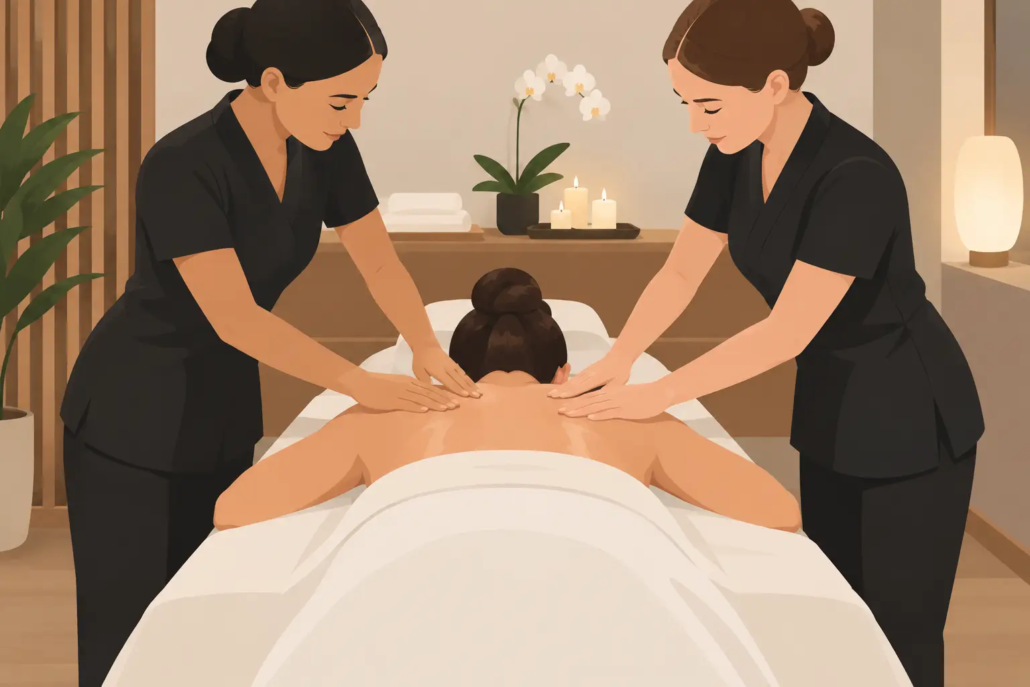
Four Hand Massage London: What to Expect
A four hand massage London appointment is not simply a massage with more hands. It is a carefully paced sensory experience in which two practitioners work in harmony, creating a fuller awareness of your body, your breathing and your capacity to receive pleasure without pressure. For many people, that shift from thinking to feeling is precisely the point.
At Intimacy Matters, sensual wellbeing is treated as a legitimate part of confidence, connection and personal health. A four-hand treatment can be deeply relaxing, arousing, emotionally restorative or quietly revealing. The experience depends on you: your intention, your boundaries, your level of curiosity and the kind of touch that feels nourishing.
What Is a Four Hand Massage?
Four-hand massage, sometimes called tandem massage, involves two trained practitioners delivering coordinated touch at the same time. Rather than working on one area and then another in a familiar sequence, the practitioners create a flowing pattern across the body. One may focus on the shoulders, arms or scalp while the other attends to the legs, feet or back. The effect can feel immersive because the mind has less opportunity to predict what comes next.
This is not about being overwhelmed. Good tandem work is attentive, unrushed and responsive. Pressure, pace, positioning and the degree of sensuality should be agreed before the treatment begins and checked throughout. You remain an active participant in the experience, even when you are lying back and allowing yourself to be cared for.
For some clients, the appeal is pure indulgence: an opportunity to switch off from responsibility, decision-making and the constant demands of city life. For others, it is a way to explore body confidence, learn what helps them relax, or reconnect with their sensual self after a period of stress, illness, change or emotional distance.
Why Two Practitioners Can Feel So Different
The nervous system responds to safe, welcome touch in ways that cannot always be reached through conversation alone. When touch is skilful and consensual, the body may soften from its habitual state of alertness. Breathing can deepen, muscles can release and thoughts may become less insistent.
With four hands, there is an added element of sensory richness. The brain cannot easily track every movement, which may encourage a more surrendered, present-moment state. Some people describe this as feeling held, cocooned or blissfully unable to overthink. Others find that it heightens their awareness of temperature, breath, anticipation and pleasure.
That does not mean a four-hand treatment is automatically right for everyone. If you are new to sensual massage, highly anxious about being observed, or prefer a slower one-to-one connection, beginning with an individual treatment may feel more comfortable. There is no prize for choosing the most adventurous option. The best experience is the one that respects your readiness.
Sensuality Without Performance
Many adults carry an unspoken pressure around touch. They worry about how their body looks, whether they will react in the “right” way, or whether they are expected to feel something dramatic. These concerns are common, particularly for people who have spent years prioritising others, dealing with relationship tension or feeling disconnected from desire.
A professionally held sensual massage space offers another possibility: pleasure without performance. You do not need to entertain, impress or achieve a particular outcome. You can simply notice what feels good, what feels unfamiliar and where you may want more space or a different pace.
That permission can be valuable for women and men alike. It can also be meaningful for people exploring bisexual or same-sex attraction, or anyone wishing to understand their erotic responses in an environment free from judgement. Curiosity is enough. You do not need a label or a perfectly formed reason for booking.
What to Expect From a Four Hand Massage in London
A premium appointment should begin before any massage takes place. You should have time to discuss your needs, relevant health considerations, preferred pressure, areas you would like included or avoided, and the level of sensuality you are comfortable exploring. Clear communication is part of the treatment, not an awkward formality.
Consent should be specific and ongoing. You can change your mind at any point, ask a question, request an adjustment or decide that an area is off limits. A respectful practitioner will welcome that clarity. Your body is not a puzzle to be solved or a service to be delivered on autopilot.
During the massage, the two practitioners may work symmetrically or in complementary rhythms. At times, both may mirror touch on opposite sides of the body. At others, one movement may lead into another, creating a sense of continuity from the feet through the legs, back, shoulders and scalp. The atmosphere is usually calm and private, with time allowed for you to arrive, settle and return to yourself afterwards.
Treatments can range from predominantly therapeutic and soothing to more explicitly sensual, depending on what has been discussed and mutually agreed. It is wise to be direct about your expectations before booking. “Sensual” can mean different things to different people, and mature communication prevents assumptions from getting in the way of a positive experience.
Who May Benefit Most?
A four-hand treatment can suit a wide range of people, but the reasons for choosing one are deeply personal. A busy professional may want an experience that makes it easier to let go. Someone emerging from divorce, bereavement or a long period without intimacy may be seeking gentle reconnection with their body. A client who feels self-conscious about arousal may value a non-judgemental setting where sensation can be noticed rather than analysed.
It can also be a thoughtful choice for established couples. Some couples book individual sessions as a way to replenish themselves before working on intimacy together. Others use a shared exploration of sensual touch as a starting point for more honest conversations about desire, affection and what has gone missing from their relationship.
A massage is not a substitute for medical care, psychotherapy or specialist sexual-health support where these are needed. However, touch can sit alongside counselling, sex and relationship coaching, and practical intimacy education. When desire has become tangled with stress, shame, poor communication or body image, combining emotional insight with embodied experience can be especially helpful.
Preparing for the Experience
You do not need to prepare perfectly. Arrive clean, hydrated and with enough time that you are not rushing from a meeting or checking your phone until the final minute. Avoid planning anything demanding immediately afterwards if you can. A four-hand treatment can leave you relaxed, reflective and less interested in returning straight to noise and obligations.
Before you arrive, consider a few simple questions. What would help you feel safe? Are there parts of your body that need particular care or should not be touched? Do you want deep relaxation, sensual awakening, reassurance around receiving touch, or simply a rare opportunity to be looked after? You do not need detailed answers, but they can help shape the session.
It is also worth releasing the idea that a treatment must produce a particular physical response to be worthwhile. Some sessions feel intensely sensual; others feel peaceful, emotional or unexpectedly grounding. The body does not perform to a script. Giving yourself permission to experience what is genuinely there is often more rewarding than chasing an outcome.
Choosing the Right Setting and Practitioner
London offers no shortage of massage options, yet intimate wellbeing calls for more than an attractive room or a vague promise of luxury. Choose a practitioner or practice that speaks plainly about boundaries, consent, confidentiality and the nature of the service. You should feel able to ask direct questions before committing.
Experience matters, particularly when a treatment touches on vulnerability, arousal or relationship concerns. A practitioner with an understanding of sexual psychology, anatomy, communication and emotional safety can offer more than technique alone. The art lies in reading the room, respecting the client and knowing that less can sometimes be more.
If you feel nervous, say so. Nervousness is not a sign that you are unsuited to sensual touch. It may simply mean that you are doing something new, personal or long overdue. A good practitioner will not rush you past that feeling. They will create the conditions in which you can decide, freely and confidently, what feels right.
The most meaningful four-hand massage is not defined by how far you go. It is defined by how fully you are able to arrive in your own body, listen to your boundaries and allow pleasure, comfort or calm to be yours without apology.
